The Unlit Parade: How London Boroughs Choose Which High Streets Glow
Photo: sludgegulper, CC BY-SA 2.0, via Wikimedia Commons
The switch-on season is upon London. Town-centre managers are counting down to crowds, choirs and the flick of a switch; in other parts of the same borough, lamp posts will remain bare. The difference is rarely a matter of festive spirit. It is a matter of budgets, boundaries and a set of quiet criteria that determine which high streets are deemed worth illuminating.
Christmas lights are one of the most visible—and least scrutinised—discretionary spends in local government. They do not sit in a statutory duty. No regulation specifies a minimum number of bulbs per mile of pavement. Instead, officers and members weigh up footfall, sponsorship potential, maintenance liabilities and the political sensitivity of leaving one parade dark while another glitters. The result is a patchwork that says as much about a borough’s commercial geography as its festive cheer.
A Tale of Two High Streets
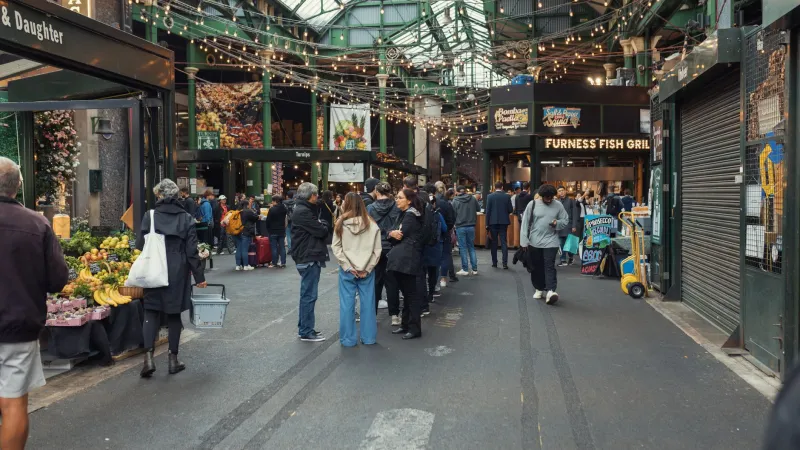
In most London boroughs, the festive budget is not spread evenly. A single town centre—often the one with the largest concentration of retail, the busiest transport interchange or the strongest business improvement district (BID)—tends to absorb the majority of the funding. Smaller district centres and suburban parades are left to rely on traders’ associations, crowdfunding or nothing at all.
The logic is partly financial. A display in a high-footfall town centre can be justified by the visitors it draws and the spending it supports. A row of shops on a residential road, with lower footfall and thinner margins, struggles to make the same case. But the logic is also administrative. Larger schemes are easier to procure, insure and maintain. A single contractor can install and take down a coordinated display across a defined area; scattering smaller installations across a borough multiplies the cost and complexity.
Barnet, for example, has in recent years concentrated its council-funded lights on flagship town centres while encouraging other areas to bid for small grants or secure local sponsorship. Bromley has similarly prioritised its historic high street. In inner London, the contrast is starker: Westminster’s West End displays are funded through a combination of council money and substantial commercial sponsorship, while high streets a few miles away in the same borough may have little more than a solitary tree.
The Criteria Behind the Current
Officers who administer these budgets describe a set of informal tests. First, footfall: is the location a designated town centre or a strategic transport hub? Second, commercial density: are there enough businesses to share the cost or justify the spend? Third, sponsorship potential: can a local developer, landlord or retailer be persuaded to underwrite the display? Fourth, maintenance and safety: are the lamp posts suitable, and who pays if a fitting fails?
These tests are rarely published. They do not appear in a formal policy document, and they vary from borough to borough. But they surface in cabinet reports and delegated decisions, often buried in a line about “festive lighting in accordance with the town centre strategy.” The effect is to make Christmas lights a proxy for a wider question: which high streets does the council consider economically significant?
That question has become sharper as budgets have tightened. Since the pandemic, several boroughs have reduced their central festive lighting budgets or frozen them, asking BIDs and traders to take on more of the cost. In some cases, the switch to sponsorship has been explicit: a local developer’s logo on the banner, a supermarket’s branding on the lights. In others, it has been quieter—a council agreeing to install the infrastructure while a business group pays for the bulbs.
BIDs and the Sponsorship Ledger
Business improvement districts have become the de facto festive lighting authorities in many town centres. Funded by a levy on local businesses, BIDs can commission displays, negotiate sponsorship and manage the switch-on event. Their involvement has professionalised the season, but it has also entrenched disparities. A BID with a strong levy base can deliver a display that a neighbouring high street without one cannot match.
Sponsorship brings its own arithmetic. A developer with a planning application nearby may be willing to fund lights as a gesture of goodwill; a retail chain may see the branding value. But sponsorship is rarely unconditional. It tends to favour locations where the sponsor’s customers already are, reinforcing the concentration of festive spend in the busiest centres.
The result is a hierarchy of light. At the top are the sponsored spectaculars, often in central London or major metropolitan town centres. Below them are council-funded displays in strategic centres. Then come the trader-funded strings and the occasional tree. At the bottom are the unlit parades, where the only glow comes from shop windows and street lamps.
What the Lights Say About Investment
It would be easy to dismiss this as a minor seasonal gripe. But the decisions behind Christmas lights mirror the wider choices councils make about high streets. The same criteria—footfall, commercial density, sponsorship potential—shape decisions on everything from street cleaning to policing to public realm improvements. A high street that cannot attract festive funding may also struggle to attract other investment.
There is also a political dimension. Councillors in unlit wards hear from residents who feel overlooked. Officers point to limited budgets. The compromise is often a small grant or a community-led scheme, which can ease the pressure without altering the underlying pattern.
As the 2026 season gets underway, the switch-ons will be photographed and shared. The unlit parades will not. Yet both are part of the same story: a capital where the festive glow is allocated not by need but by a calculus of footfall, sponsorship and administrative convenience. Understanding that calculus is the first step towards debating whether it is the right one.