The Hours Between: How London’s Library Timetables Became Budget Policy
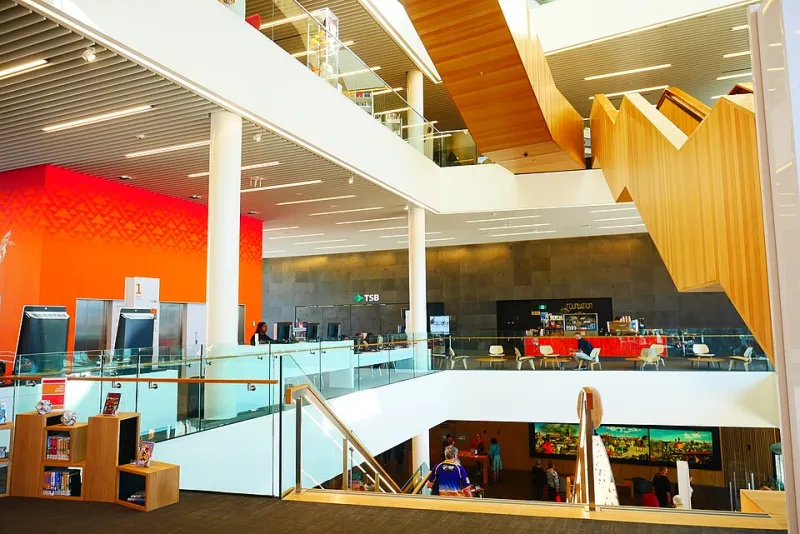
Photo: Sgerbic, CC BY-SA 4.0, via Wikimedia Commons
On a wet Tuesday in November, the lights above the fiction shelves in an outer-London library go off at six. The building is warm, the Wi-Fi is working, and a group of teenagers is still at the tables. A staff member explains that the late shift ended at 5.30. The doors close. The timetable, printed on laminated card and pinned by the entrance, has become the most consequential document the library service produces.
That is not rhetorical flourish. Across the capital, library opening hours are being recast in 2026-27 budget papers as councils try to reconcile three pressures that pull in different directions: the cost of staffing buildings, the backlog of maintenance, and rising demand for warm, connected public space. The result is a patchwork of late openings, dark Saturdays and shortened mornings—each one justified in the language of local priorities.
The statutory floor and the local ceiling
The legal starting point is the Public Libraries and Museums Act 1964, which requires local authorities in England to provide a “comprehensive and efficient” library service. The Act does not specify hours. Ministers have resisted repeated calls to define a minimum timetable, arguing that local circumstances vary. That leaves councils to decide what “comprehensive” means in a borough where the central library is a Victorian landmark and the branch library is a 1970s shopping parade unit.
In practice, the decision turns on a simple ratio: the number of staffed hours a building can offer against the cost of keeping it open. A library that opens for 40 hours a week needs rotas, cover for sickness and holiday, and a manager on site for at least part of the day. Cut two hours from a Saturday and the saving is not just two hours’ pay; it is the shift premium, the security cover and the cleaning window that move with it.
The staffing arithmetic
Council papers published this autumn show the same calculation recurring. Several boroughs have modelled savings by reducing evening openings, arguing that footfall after 7pm does not justify the staffing cost. Others have protected late nights in central libraries while trimming hours at smaller branches. The pattern is not uniform, but the logic is: hours follow usage, and usage is measured by gate counts that favour busy, well-connected buildings.
The risk is that gate counts become self-fulfilling. A branch that closes at 5pm on weekdays will record low evening use. A library that shuts on Saturdays will not count the Saturday readers who went elsewhere. Officers acknowledge the problem in consultation papers, but the data often arrives after the decision has been framed as a budget saving.
Warmth, Wi-Fi and the demand map
The other pressure is demand for what libraries now provide beyond books. Warm spaces, free computer access, printing, form-filling help and a quiet place to sit have made the library a de facto social service. In winter, those functions matter more. Voluntary groups have warned that reduced hours push older residents towards other public buildings—or home.
The geography of that demand is uneven. Inner-city branches near transport hubs see steady all-day use. Suburban branches see spikes after school and on Saturdays. A timetable that suits one does not suit the other. Councils are increasingly trying to differentiate: keeping one “core” library open late, while smaller branches offer shorter, more predictable hours. The trade-off is that predictability for the service can mean unpredictability for the resident who works until 6pm and relies on a Thursday evening visit.
The weekend question
Saturday opening is the sharpest expression of the dilemma. It is also the most expensive. Staff who work Saturdays often attract premium pay, and the building needs full cover. Several boroughs have moved to a five-day week for smaller branches, arguing that the saving protects weekday access for schools and jobseekers. Others have kept Saturday mornings but closed on Wednesdays—a change that confuses residents and frustrates councillors.
Public consultation rarely resolves the question. Residents turn out to defend the hours they use. The result is a familiar pattern: the central library keeps its Saturday, the branch loses it, and the equalities impact assessment notes that the change may affect older people and those with caring responsibilities. The assessment is published, the decision is taken, and the timetable is reprinted.
What to watch in 2026-27
The next round of decisions will be shaped by three things. First, the local government finance settlement, expected in December, will set the envelope for library budgets. Second, building maintenance is becoming urgent: several London libraries need roof repairs or heating upgrades that cannot be deferred. Third, the demand for warm space is not going away. If councils cut hours to save money, they may find themselves paying elsewhere—through increased pressure on day centres, advice services and health partners.
For now, the timetable remains the quiet instrument of policy. It does not appear in manifesto pledges. It rarely makes the front page. But it decides who can use a public building after dark, and that is a decision worth watching. The hours between opening and closing are where the budget meets the borough.