One Counter, Many Landlords: Inside the Deal That Puts a Banking Hub on a London High Street
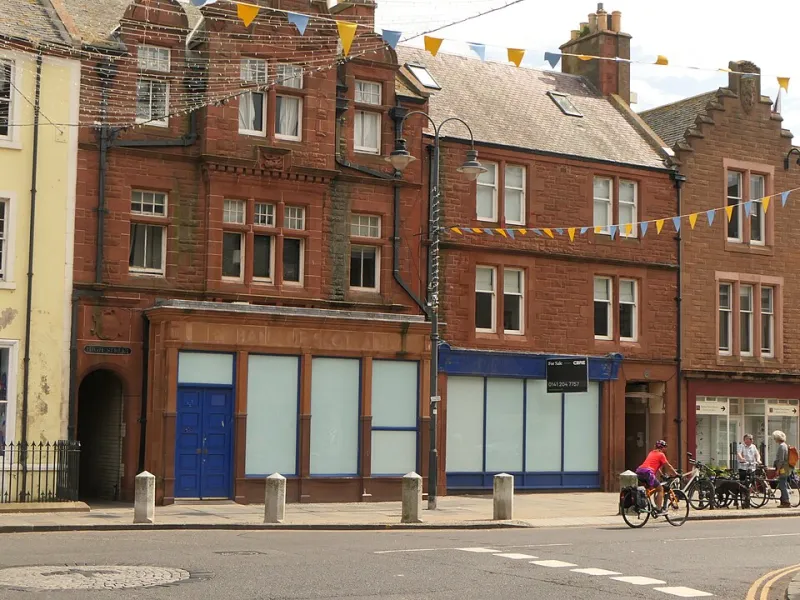
Photo: Richard Webb , CC BY-SA 2.0, via Wikimedia Commons
On a stretch of high street in an outer London town centre, the shutters come down on a branch and the argument starts. The bank says footfall has fallen and the counter is barely used. The council says the closure removes the last place where a pensioner, a market trader or a charity treasurer can pay in cash without a bus ride. Both are probably right. What follows is not a rescue, but a process — and the process is where the capital's banking hubs are actually decided.
The test before the counter
A banking hub is a modest proposition dressed as a solution. Typically it occupies a shop unit, staffed by Post Office employees at a counter that handles cash withdrawals, deposits and bill payments, with community bankers from the major banks attending on set days to deal with account queries. It is not a branch. It does not lend, it does not open accounts, and its business banking is deliberately limited.
Getting one is not a matter of petitioning a bank. Since September 2024, the Financial Conduct Authority has required banks and building societies to assess whether a closure, or the loss of a core cash service, leaves a gap that needs filling. Those assessments are meant to weigh local circumstances: the distance to the nearest alternative, the cost of the journey, the number of elderly or vulnerable residents, the quality of digital connectivity, and the dependence of small traders on cash takings. LINK, the network that runs the UK's cash machine system, reviews the results and can recommend a hub. Cash Access UK, a company owned by the banks, then has to find premises and staff it.
That sequence explains why London's rollout has an uneven shape. A high street can fail the assessment on a technicality — a Post Office counter a mile away that meets the letter of the criteria — and then wait years for a review. Councils complain that they see the conclusion but never the calculation. LINK publishes its recommendations; it does not publish the working.
Who writes the cheque
On paper, nobody in local government pays for a hub. The funding comes from the banks, routed through Cash Access UK, on the logic that institutions that withdraw from a community should contribute to the substitute. LINK has committed to more than a hundred hubs nationally, and the capital's share is small but growing, clustered in outer boroughs where closures have been concentrated and where car ownership does not automatically solve the problem for those without one.
The cost, of course, does not disappear. It is carried by the banks and, in time, by their remaining customers, and it is capped. A hub is cheaper to run than a branch: fewer staff, smaller premises, no lending desk, no safe deposit boxes, no mortgage adviser. That is precisely what makes it attractive to the industry and, to its critics, what makes it a holding pattern rather than a service. The suspicion in town halls is that the hub does the political work of a branch at a fraction of the cost, and that the assessment regime gives closures a respectable paper trail.
The council's role: advocacy without authority
Borough officers have become adept at the soft side of the process. They supply footfall data, they broker conversations with landlords about rents, they point Cash Access UK towards vacant units in regeneration schemes, and they occasionally use compulsory purchase or planning leverage to keep a site in retail use. What they cannot do is decide.
That imbalance grates. A council can spend millions on a high street renewal programme — new paving, lighting, a market square — and then find that the bank on the corner has gone and the hub has been placed two streets back, in a unit with a shorter lease, because that was what the commercial agent could secure. Members raise motions, write to the Treasury, and are told the framework is national and evidence-led. It is, in the narrow sense. It is also insulated from the local democratic argument that a closure is not just a service loss but a blow to the viability of every shop around it.
The question of duration
Perhaps the sharper concern is time. Hub commitments are not framed as permanent infrastructure. They are reviewed, and reviews depend on usage, and usage depends on awareness, and awareness depends on the very local presence that a stripped-back counter can struggle to build. There is a version of the next few years in which hubs become a fixture, quietly knitted into the high street alongside the library and the pharmacy. There is another in which they are assessed again, found to be underused, and withdrawn — leaving a town that has already lost its branch with nothing at all.
Small business owners are the most exposed. A market trader who needs to bank takings at four in the afternoon, or a shopkeeper who wants change, has limited patience for a counter with restricted hours and a queue. The banks say the demand is not there for a full branch; the traders say the branch was made inconvenient and then declared unwanted. Both claims can be tested, but only with data that is rarely published in a form anyone can interrogate.
What to watch in 2026
The immediate questions are practical. How many of the capital's recommended hubs will have opened by the end of the financial year, and in which boroughs? Will the FCA's first round of post-implementation scrutiny push banks to explain their assessments more fully, or simply confirm that the rules are being followed? And will councils be given anything more than a consultative role when a site is chosen — or will they keep discovering, as they do now, that the decision about their high street was taken in a room they were never in?
Access to cash is not nostalgia. It is the plumbing of a local economy, and London's outer boroughs are where the pipes are thinnest. A counter is better than nothing. The argument that will define the next few years is whether better than nothing is the standard the capital should accept.