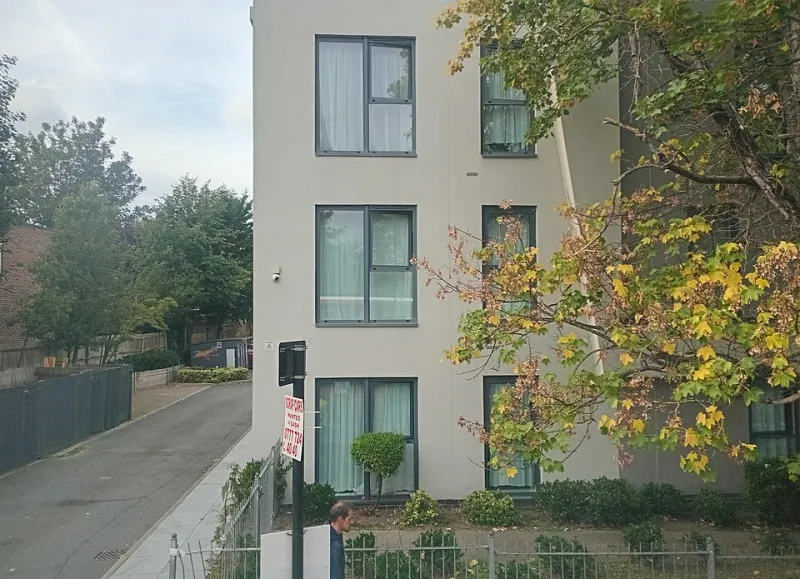
Scaffold Season Never Ends: What London’s Cladding Repairs Are Costing the High Street
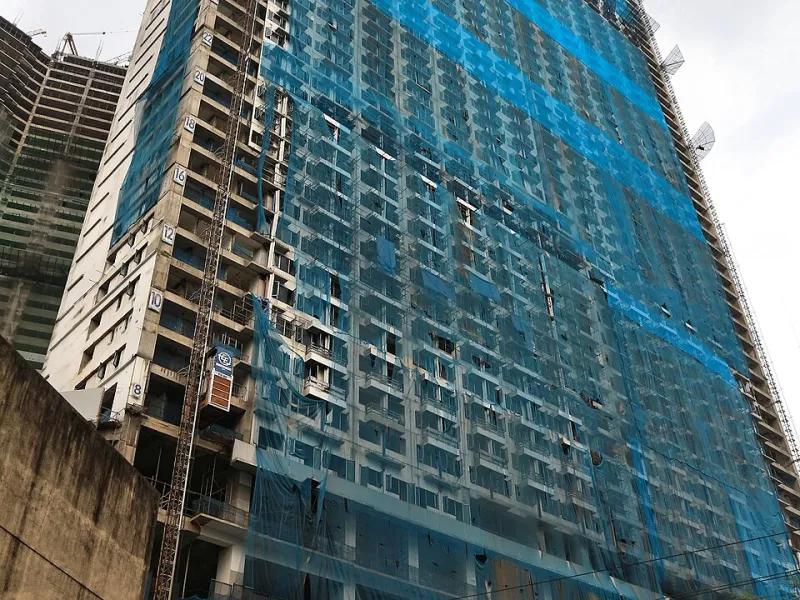
Photo: Marek Ślusarczyk (Tupungato) Photo portfolio, CC BY 3.0, via Wikimedia Commons
More than nine years after the Grenfell Tower fire, the capital’s cladding repair programme has become a permanent feature of the London streetscape. On the Barking Road, along parts of Croydon’s London Road, on the parades that fringe the North Circular, the same arrangement recurs: a tower wrapped in monochrome netting, a tower crane overhead, and at street level a row of shops trading in shadow behind heras fencing and a plywood hoarding.
For the leaseholders above, the policy debate is well rehearsed — who pays, which costs are capped, how the Building Safety Act 2022 protections apply. For the businesses below, there is no equivalent framework. Their difficulty is not a legal one so much as an administrative vacuum: nobody is formally tasked with minimising the commercial damage that remediation does to the high street, and nobody is obliged to compensate for it.
A programme measured in years, not months
The pipeline is large. The Cladding Safety Scheme and the developer remediation contract, signed by more than 50 of the country’s largest housebuilders, together cover thousands of buildings nationwide, with a substantial concentration in London. The government’s Remediation Acceleration Plan, published in December 2024, set a target of remediating or committing to a completion date for all buildings over 18 metres by the end of 2029 — a deadline that, on any realistic reading, means works commencing across the capital through 2026 and 2027.
The practical consequence is that a scaffold erected this year may well still be standing in 2028. For a café, a pharmacy or a dry cleaner, that is not a construction inconvenience; it is the entire trading horizon of the business.
Four decision-makers, one pavement
A common misconception, heard in council chambers as much as on the shop floor, is that ‘the council’ is running the job. It is not. Responsibility is split four ways, and only one of those ways gives a borough meaningful leverage.
The freeholder — or the residents’ management company, where the leaseholders have taken control — commissions the work. The managing agent procures it. The principal contractor sequences it, and will generally keep the scaffold up for the whole programme rather than repeatedly erect and strike it, because that is cheaper and safer. And the Building Safety Regulator, within the Health and Safety Executive, oversees the higher-risk buildings in scope.
The borough’s real power is narrower and more literal: the pavement. Under section 169 of the Highways Act 1980, a scaffolding licence is required where works occupy the public highway, and the highway authority sets the conditions — duration, lighting, protective fans, the width of the walkway left for pedestrians. Some boroughs charge for the licence and some do not; some impose time limits, some do not. It is the one point in the process where a council can lawfully say no, or say ‘not like that’.
That licence, however, governs the fence. It does not govern the building, the funding round, the contractor’s programme or the freeholder’s urgency — none of which a local authority can direct.
Where the time actually goes
Interviews with those involved in remediation schemes point to a familiar sequence of delays: intrusive surveys that reveal more than the desk study suggested; design changes that require fresh building control approval; grant funding rounds that open and close; and, increasingly, commercial negotiations between developers and contractors about who absorbs cost overruns. A building safety case must be assembled and maintained under the new regime. None of this is frivolous, and much of it is unavoidable. But it is measured in quarters, and every quarter is a quarter of trading.
What shopkeepers can actually use
The remedies available to affected traders are real but modest. Business rates offer the most concrete route: ratepayers can appeal to the Valuation Office Agency for a reduction on the grounds of a material change of circumstances, and billing authorities have discretion under section 47 of the Local Government Finance Act 1988 to grant relief. In practice, take-up is low, awareness lower, and relief is time-limited and locally funded — which, in a year when borough budgets are again under severe strain, matters.
Lease terms are the second lever. Some commercial leases contain abatement provisions for interruption, and service charge disputes can be pursued where management costs are poorly evidenced. Beyond that, the legal ground thins quickly. A claim in nuisance against a contractor operating under a lawful licence and reasonable working hours is difficult; compensation under the Party Wall etc. Act 1996 is narrowly construed; and there is no statutory compensation scheme for what might be called scaffolding blight, in contrast to the settled entitlements that follow a compulsory purchase order.
The gap nobody owns
Local government has begun to notice. A number of boroughs have folded remediation disruption into high street support work — signposting, business rates advice, occasional discretionary funds — and the Local Government Association has argued that the burden of a national safety programme should not fall on local high street budgets. Westminster has so far declined to create a compensation or relief framework specific to remediation works, preferring to treat the issue as a matter between landlords, contractors and tenants.
That position is defensible in principle and increasingly awkward in practice. The safety obligation is statutory and non-negotiable; the disruption is a direct consequence of meeting it; and the costs land on the party least able to influence either.
What to watch in the next twelve months
Three things will shape how this looks by the end of 2027. First, the Building Safety Levy, which begins to apply to developers from October 2026, will change the economics of schemes and may sharpen incentives to get buildings signed off and scaffolds down. Second, the 2029 remediation milestones will force landlords to publish credible completion dates — dates that tenants can, for the first time, hold them to. Third, the April 2026 rating revaluation has reset rateable values across the capital; traders who have not yet checked whether their new assessment reflects a scaffolded frontage should do so before the appeal window narrows.
None of this amounts to a remedy. It amounts, for now, to better information — which is what the high street underneath the netting has been short of since the first hoarding went up.